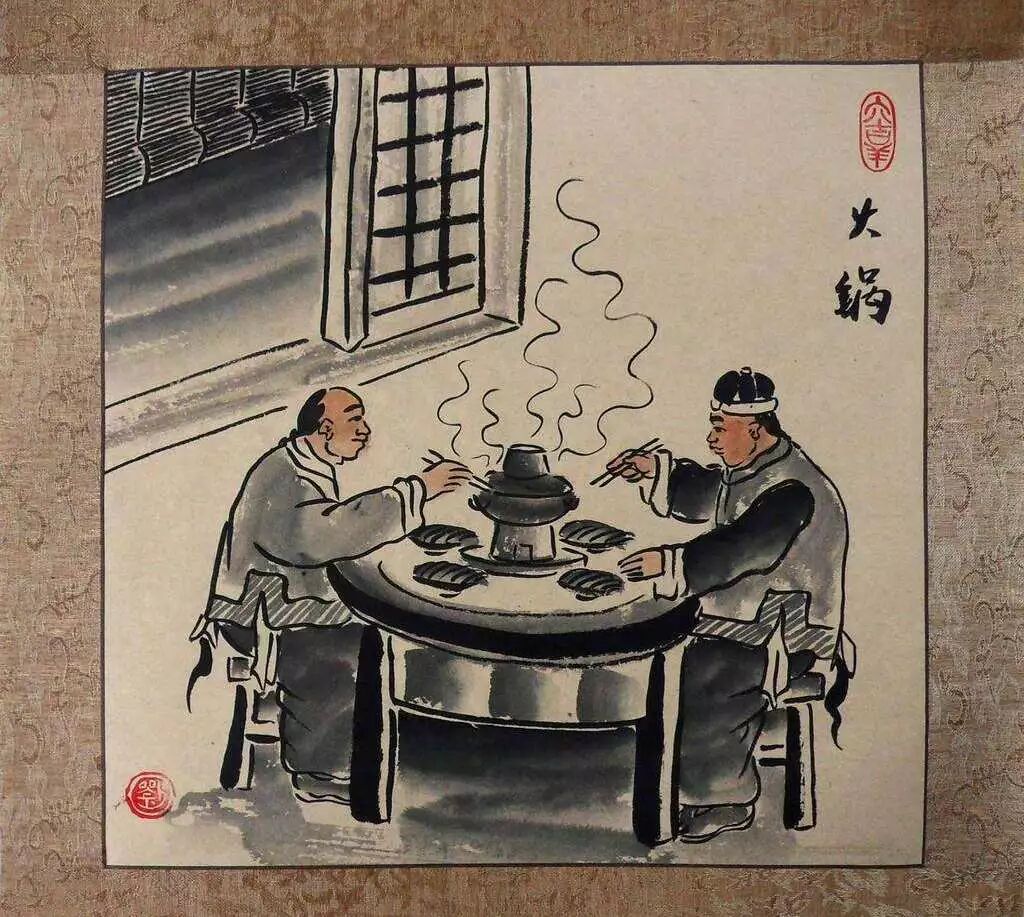
The definition of hot pot includes three aspects: first, a dining method where people gather around a stove; second, a cooking method where fish, meat, and vegetables are cooked in boiling broth and eaten immediately; and third, a specific dish name. Only when these three elements are combined can we refer to the "hot pot" that has been widely discussed since modern times.
According to this definition, a review of the vast classical literature reveals that "hot pot" originated in the Tang Dynasty and developed in southern China, resulting from the collision and integration of the dietary customs of various ethnic groups in the south. This will be discussed below.
The famous Tang Dynasty poet Bai Juyi wrote a five-character regulated verse called "Asking Liu Nineteen," which goes: "Green cicadas, new brewed wine, red clay small stove. In the evening, the sky is about to snow, can you drink a cup?" This poem was written in the twelfth year of the Yuanhe era (817 AD), when Bai Juyi was 46 years old and serving as a magistrate in Jiangzhou (now Jiujiang City, Jiangxi Province). Liu Nineteen, a recluse from Songyang, is not well-documented. This poem depicts the scene of the poet inviting a friend to drink wine and share heartfelt conversations on a cold winter evening. The poet invites his friend Liu Nineteen: in the cold winter season, as dusk falls and snow is imminent, I have prepared freshly brewed green wine, and the stove is already warm; can you come over for a drink? Many articles discussing the historical origins of hot pot often reference this poem. However, while the poem appears to describe drinking around a stove, it is uncertain whether there was a boiling pot of soup on the stove. We can only use our imagination; perhaps there was. Certainly, the imagery described in this poem is only a step away from what we discuss today regarding eating hot pot!
Tang Dynasty author Liu Xun, edited by Lu Xun, in "Records of Strange Things from Lingbiao" Volume One: "The people of Jiaozhi emphasize 'Bu Nai Geng.' Geng is made by boiling sheep, deer, chicken, and pig meat together with bones in one pot, making it extremely rich and thick. After straining the meat, add scallions and ginger, season with five flavors, store it in bowls, and place it on plates. In the soup, there is a silver ladle that can hold one liter. When serving, many people serve their own first, and then fill a ladle, bringing it to their mouths and noses, tilting their heads back to drink it all, like drinking wine. After eating the soup, various dishes are added, called 'Bu Nai Hui' (also called 'Xian Yu' as well). The people of Jiaozhi may be busy with affairs, but when this gathering is set, there is no one who does not harmonize."
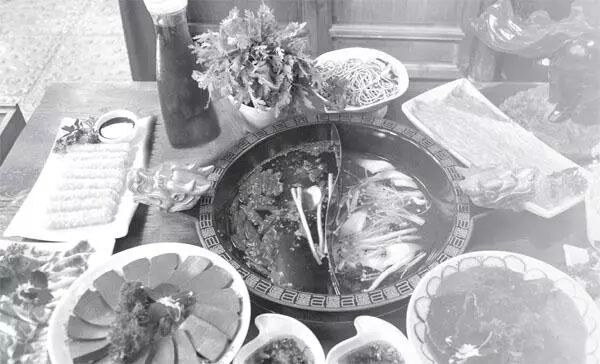
The author of "Records of Strange Things from Lingbiao," Liu Xun of the Tang Dynasty, lived during the reign of Emperor Zhaozong (889-904 AD) and served as a magistrate in Guangzhou. After his term ended, due to turmoil in the capital Chang'an, he was unable to return to report on his duties and remained in Guangzhou. Based on what he heard, saw, and experienced locally, he authored a three-volume book "Records of Strange Things from Lingbiao." The information cited from this book reflects the dietary customs of the Yue people in the Lingnan region of China during the late Tang Dynasty. They made a type of soup called "Bu Nai Geng" (Song Dynasty Zhu Fu's "Ximan Congxiao" states: Bu Nai is a phonetic transcription). This soup's preparation method is "boiling sheep, deer, chicken, and pig meat together with bones in one pot, making it extremely rich and thick, straining the meat, adding scallions and ginger, and seasoning with five flavors," similar to today's hot pot soup base; then "storing it in bowls and placing it on plates." The stove was not placed on the table, so it was not a gathering around a stove, but what we now call a "cold pot." Drinking with the nose, rather than the mouth, is a custom of some ancient southern ethnic groups. The Southern Song Dynasty's Zhu Fu in "Ximan Congxiao" states: "The people of the Liao (i.e., the Liao people) drink not with their mouths, but with their noses, taking their convenience."
"Bu Nai Geng" was once popular in the Jiaozhi region. Jiaozhi was the ancient residence of the Yue people, so it is likely that this custom spread among the Yue people. The Yue people used the method of "nose drinking" to consume soup, calling it "Bu Nai Geng"; when the method of "nose drinking" was lost, they began to eat meat and soup together, calling it "Gu Dong Geng."
The Northern Song Dynasty's Su Shi in "Notes on Qiu Chi: Pan You Fan Gu Dong Geng": "Luo Fu Ying Lao took all kinds of food and mixed them, calling it 'Gu Dong Geng.'"
The Southern Song Dynasty's Zhu Mu in "Fang Yu Sheng Lan: Huizhou" (Volume 36): "(The locals) also like to make Gu Dong Geng, taking all kinds of food and mixing them. Daoist Lu's poem: 'Throwing the Gu Dong Geng pot, digging the cave in the rice bowl.' Su Zizhan was very happy to see this."
The Southern Song Dynasty's Zeng Can in "Gao Zhai Man Lu" records: "In the Zen forest, there is food that is not finished, all thrown into a large pot to be boiled, called Gu (bone) Dong Geng. What Dongpo used was this matter, also something that had not been used by previous generations."
The Tang Dynasty's Yue people's "Bu Nai Geng" developed into "Gu Dong Geng" in the Southern Song Dynasty, and by the Qing Dynasty, it became Guangdong's hot pot "Da Bian Lu." There are numerous records in Guangdong's local chronicles and poetry. For example:
Qing Dynasty's Chen Kun in "Poems of Lingnan Miscellaneous Matters" Volume Four, "Gu Dong Geng" entry: "Food without a bottom cost a thousand coins, Gu Dong Geng's fragrance surpasses the exquisite banquet. What is the point of being pretentious and artificially created? The unique flavor is natural." The author notes: "In Huizhou and other places, taking all kinds of food and mixing them is called Gu (Jiang's note: i.e., Gu) Dong Geng."
Qing Dynasty's Guan Han in "Lingnan Miscellaneous Essays" "Brief Overview of Southern Speech" entry: "Gu Dong Geng, on the winter solstice, the people of Guangdong make round rice cakes to worship the gods of the room, and also mix fish and meat to cook. Dongpo called it Gu Dong Geng, also called Da Bian Lu, meaning to eat around the pot."
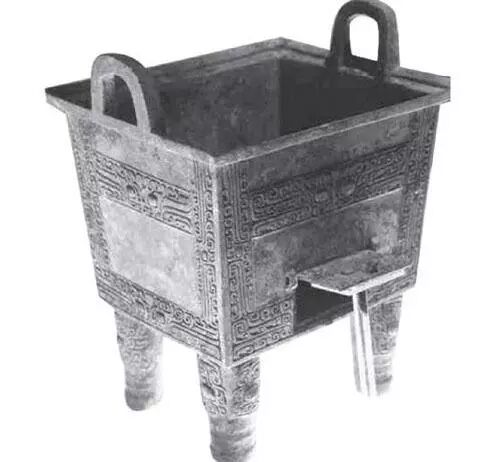
The square bronze warming pot with beast face patterns (early hot pot, unearthed in 1989 at the late Shang Dynasty site in Jiangxi Xingan)
Qing Dynasty's Qianlong fifteenth year edition of "Shunde County Chronicle": "On the eleventh month, 'Winter Solstice worships ancestors, inviting clan members. When the wind is cold and guests are summoned, fish, meat, preserved flavors, clams, and vegetables are mixed and boiled, eating around the pot, called 'Bian Lu,' which is Dongpo's Gu Dong Geng."
Qing Dynasty's Qianlong forty-eighth year edition of "Guishan County Chronicle": "Old customs have 'Pan You Fan,' burying fresh meat in rice, and when it arrives, everyone laughs and says 'digging the cave.' They also mix various dishes in the pot and cook together, called Gu Dong Geng. The poet Lu Daoist wrote a poem: 'Throwing the glue into the Gu Dong Geng pot, digging the cave in the rice bowl.' Dongpo was very happy and personally wrote it down. In Guishan County, ordinary family meals are very frugal; even though fish and meat in the market are sold by weight, they are still cut into small pieces, which is quite frugal. Guishan County was established during the Sui Dynasty and was an attached county of Huizhou Prefecture during the Ming and Qing Dynasties. It was renamed Huizhou County during the Republic of China and is now Huizhou City.
Qing Dynasty's Daoguang third year edition of Guangdong's "Kaiping County Chronicle": "On the eleventh month, 'Winter Solstice, making round rice cakes to worship ancestors. Mixing fish and meat to boil, eating around the pot, called 'Da Bian Lu,' also known as 'Gu Dong Geng.'"
Qing Dynasty's Daoguang fifth year edition of Guangdong's "Enping County Chronicle": "On the eleventh month, 'Winter Solstice, making rice balls to worship ancestors. Eating raw fish is a family feast, mixing fish and meat to cook, eating around the pot, called 'Da Bian Lu,' which is Dongpo's Gu Dong Geng. Whenever it is cold, guests are all served this."
Qing Dynasty's Daoguang nineteenth year edition of Guangdong's "Xinning County Chronicle": "On the eleventh month, 'Winter Solstice worships ancestors, from the first ancestor to the ancestors. Mixing fish, meat, clams, and vegetables to boil, eating around the pot, called 'Bian Lu,' which is what Dongpo said 'Gu Dong Geng.'"
Qing Dynasty's Daoguang twenty-first year edition of Guangdong's "Xinhui County Chronicle": "On the eleventh month, 'Winter Solstice, worshiping ancestors from the first ancestor to the ancestors. Mixing fish and meat to boil, eating around the pot, called 'Bian Lu.'"
Qing Dynasty's Guangxu sixteenth year edition of Guangdong's "Hua County Chronicle": "On the eleventh month, 'Winter Solstice, the scholars celebrate each other. ... On this day, many eat fish sashimi, which is said to be beneficial to people. If the wind is cold, they will drink and use mixed cooking around the pot, called 'Da Bian Lu,' which is Dongpo's 'Gu Dong Geng.'"
Qing Dynasty's late Qing and early Republic of China Xu Ke compiled "Qing Miscellaneous Notes: Food Category" entry: "Small drinking at the edge of the pot" entry: "In the winter days of the capital, wine houses have edge pots set up, created by a certain merchant, hence called edge pot, suitable for small drinking. The method of eating is similar to the capital's hot pot, but besides chicken, fish, sheep, and pigs, there are also chicken eggs, indicating that the Cantonese already knew the rich protein of chicken eggs." "Created by a certain merchant, hence called edge pot" is a commonly used explanation by merchants, which is self-evident.
In the sixteenth year of the Republic of China, the lead-printed edition of Guangdong's "Dongguan County Chronicle": "On the eleventh month, 'Winter Solstice, worshiping ancestors. (The 'Zhou Chronicle' and 'Nanhai Chronicle': When the winter solstice meets cold winds, many prepare 'Gu Dong Geng' to entertain guests, called 'Bian Lu.' The method is to prepare a warm stove with fish, meat, clams, and vegetables mixed and boiled, eating around the pot. According to the customs of Dongguan, it is called 'Da Bian Lu.' On this day, they also eat raw fish. The saying goes: 'Winter solstice fish raw, summer solstice dog meat.')"
From the above historical materials, it is clear that today's Guangdong hot pot has evolved from the Tang Dynasty Yue people's "Bu Nai Geng" dietary customs.
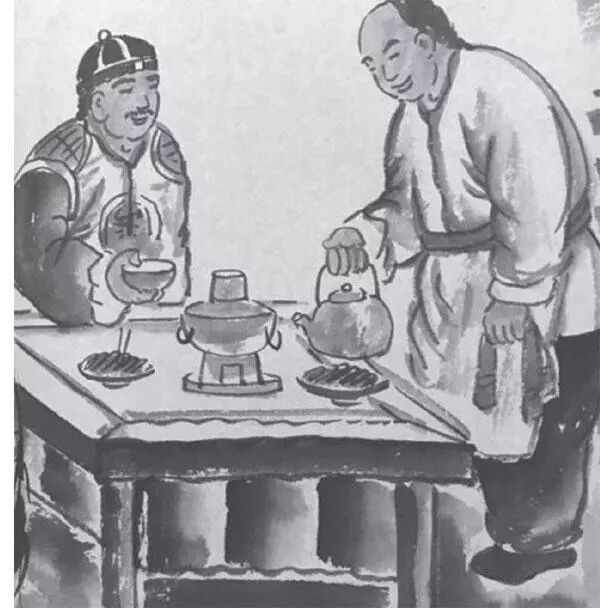
So, how did today's Beijing "Shuan Yang Rou" hot pot come about? It also originated in the south, probably during the Song Dynasty.
The Southern Song Dynasty's Lin Hong in "Shan Jia Qing Gong" "Bo Xia Gong": "When traveling to Wuyi's Liuqu, I met a snow day and caught a rabbit. There was no cook to prepare it. The master said: In the mountains, just use thin slices (Jiang's note: thin slices means thinly cut), marinate with wine, sauce, and pepper (Jiang's note: marinate means to soak or pour). Use a small stove to set it up, wait for the soup to sound a cup (Jiang's note: here should be a missing 'wine' character) later. Each person uses chopsticks to pick it up and cook it in the soup until it is cooked, then eat it with sauce as desired. Therefore, using this method is not only easy but also brings warmth and joy. After five or six years, I returned to the capital (Jiang's note: referring to the Southern Song capital Lin'an, now Hangzhou), and I saw this again at Yang Yongzhai's banquet, feeling as if I had been separated from Wuyi for a lifetime. Yang Xun's family loved ancient studies and lived a simple life, which suited the interests of the mountain family. Therefore, I wrote a poem: 'Waves surge on the clear river, the wind flips the evening glow. In the end, I drunkenly recall the taste of the mountains, forgetting that the honored guest has arrived.' Both pigs and sheep can be used. "Bencao" states: 'Rabbit meat nourishes the middle and benefits qi, and cannot be eaten with chicken.'
This historical material describes the Southern Song Dynasty's hermit eating "rabbit meat hot pot," which has similarities to today's Beijing "Shuan Yang Rou," such as slicing the meat thinly, "each person uses chopsticks to pick it up and cook it in the soup until it is cooked, then eat it with sauce as desired," which is quite similar to the way of eating Beijing's Shuan Yang Rou. The difference is that before the rabbit meat slices are put into the pot, they are marinated with wine, sauce, and pepper to remove the gamey taste; southern cooking is very meticulous. As for the soup pot using a small stove, that is due to the small number of people, just two people, so there is no need for large copper or iron pots. This historical material also highlights two benefits of eating hot pot: one is convenience and ease, and the other is the joy of warmth and togetherness. Finally, it also mentions that both pigs and sheep can be "shuan," which can naturally be seen as the source of Beijing's Shuan Yang Rou.
The Ming Dynasty's Song Xu in "Zhu Yu Shan Fang Miscellaneous Parts" Volume Three "Health Preservation Section" entry introduces two methods of eating raw beef: "One is to cut it thinly across the grain (cutting it thinly across the grain), marinate with wine, sauce, and pepper, and quickly put it into boiling soup. Any fresh bamboo shoots, scallions, and similar items should be cooked first. One method is to put the meat into a container, pour pepper sauce over it, and let it boil, which is the color used." ("Li" states: "When cutting thinly, it must be cut against the grain.") The first method of eating is similar to the Southern Song Dynasty's Lin Hong's "Bo Xia Gong" rabbit meat hot pot, such as "cutting thinly across the grain, marinating with wine, sauce, and pepper, and quickly putting it into boiling soup." The difference is that one is rabbit meat slices, and the other is beef slices. Wang Shixiang's preface to "Chinese Famous Dishes: Beijing Flavors" also cites this material; however, Wang changed "raw beef" to "raw lamb" to prove that "Shuan Yang Rou has at least a history of four hundred years." In fact, there is no need to stretch the truth; it is unnecessary. Since the "Bo Xia Gong" entry of "Shan Jia Qing Gong" already states that "both pigs and sheep can be shuan," of course, "beef" can also be shuan. Adopting the materials from "Bo Xia Gong" to prove that Shuan Yang Rou originated in the Song Dynasty would only add another 400 years to its history, wouldn't that be better? Song Xu, courtesy name Jiufu, was from Huating, Songjiang (now Songjiang District, Shanghai) during the Ming Hongzhi period (1488-1505). This method of shuan beef and lamb hot pot was initially a dietary custom of Jiangnan. During the Ming and Qing Dynasties, Beijing became the capital, and with the gathering of culture, this dietary custom naturally flourished in Beijing.
In the late Qing and early Republic of China, Xu Ke compiled "Qing Miscellaneous Notes: Food Category" entry: "Small drinking at the raw hot pot" entry states: "In the winter days of the capital, wine houses have a small pot, with soup inside, heated from below, placing slices of chicken, fish, sheep, and pig meat on the plate, allowing guests to put them in, waiting for them to cook and eat. Some even add chrysanthemum petals, calling it chrysanthemum hot pot, suitable for small drinking. Since everything is cut fresh and into thin slices, it is called raw hot pot."
Chong Yi wrote in "Miscellaneous Records of the Court and the People since Daoguang": "In terms of food, during the Daoguang period, customs were still simple, and banquets had no new tricks. During the Xianfeng period, due to military actions in various provinces, the families of scholars in the capital often avoided extravagance and had no time to pursue food. By the time of Tongzhi, after the pacification of the Taiping and Nian rebellions, people's hearts were settled, and the food served at banquets increased to more than fifty varieties. Generally, a banquet would have twenty dishes to accompany the wine, including four fresh fruits, four dried fruits, four candied fruits (such as red fruits, sweet tang, warm plum, and apricot dried fruits, prepared for pouring milk desserts), and eight cold dishes (or using four large platters, each platter with two kinds). The first recommendation is eight treasure fruit soup or steamed lotus seeds (all using large sea bowls); next is bird's nest, and then add shark fins, with roasted whole pigs and whole ducks as the highest grade (i.e., roasting whole pigs, whole ducks on the plate), or replacing them with steamed ducks and whole fresh fish. In summary, there are five large dishes, and eight small stir-fried dishes (called small stir-fries), with three types of desserts in between, each person having one portion, called each eating. One sweet dessert, two milk desserts (mostly thick milk skin in small bowls, mixed with sweet fruits), and three meat desserts (such as dumplings, spring rolls, etc.). Finally, four large soup dishes and four stir-fried dishes are served as the finale. In winter, there is also a ten-jin hot pot, which is considered extravagant. I was still young enough to witness this grand banquet, but the dishes varied greatly, this is just a general overview." "In winter, there is also a ten-jin hot pot, which is considered extravagant." This shows that after the Tongzhi period, as the lives of the scholars in the capital became increasingly extravagant, the "ten-jin hot pot" had become a signature dish at winter banquets.
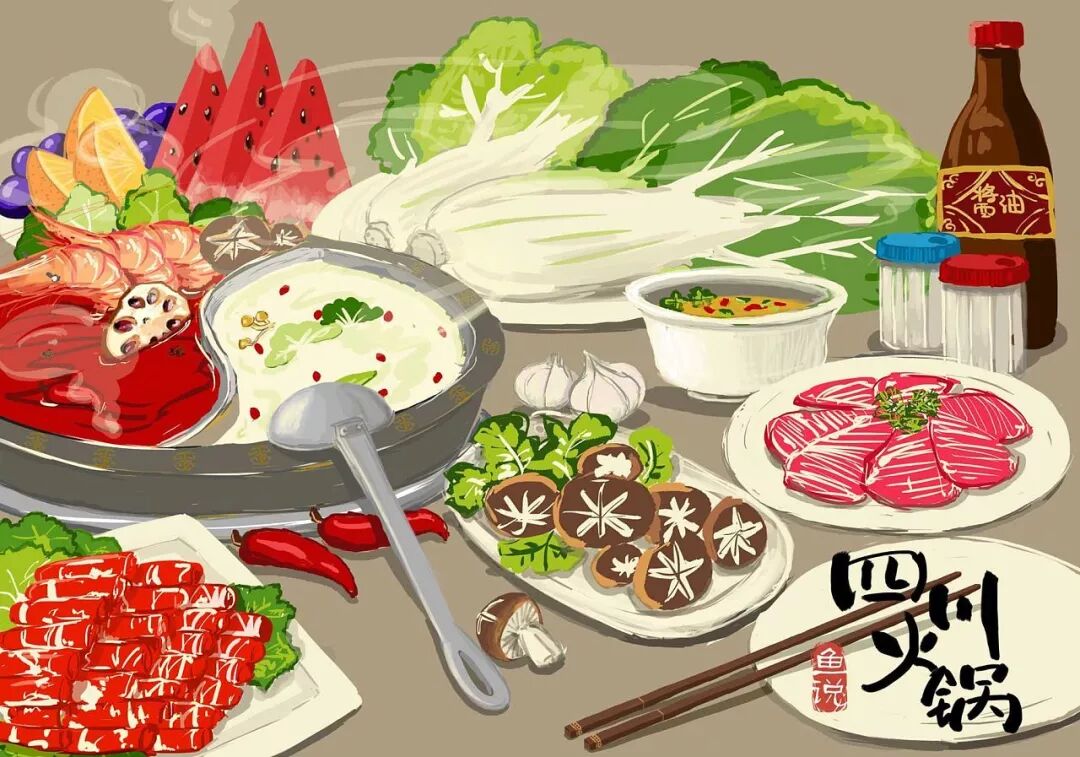
The rise of hot pot among Sichuan people began in the Ming and Qing eras, divided into two types centered around Chengdu in the western Sichuan region and Chongqing in the eastern and southern Sichuan regions. Chengdu hot pot uses a copper hot pot stove, with a copper chimney in the middle, and below is a furnace that burns less smoky green charcoal. Surrounding the chimney is a pot for holding fish, meat, and vegetables, with a compartment below for ash from the furnace, and the hot pot base is placed in a copper tray on the dining table.
Earlier Chengdu hot pot had a light flavor, similar to Beijing's "ten-jin hot pot" and "chrysanthemum hot pot." The history of this hot pot is quite long, as inferred from the Sichuan provincial intangible cultural heritage list "Huili County Red Copper Hot Pot Making Technique." The people of Huili enjoy cooking with copper hot pots all year round. Almost every family has a copper hot pot, which is round on top and flat on the bottom, resembling a ding, with a strong Central Plains cultural flavor. It is said that during the Ming Dynasty, Zhu Yuanzhang, to pacify the remnants of the Yuan Dynasty's rebel army, implemented military settlements in Huili, and soldiers from the Central Plains brought advanced techniques and culture at that time; coupled with Huili's historical copper production, it gave rise to the unique Huili copper hot pot. Starting from the Hongwu period of the Ming Dynasty, Huili's mining industry began to prosper. Places like Lichang, Lixi, and Tong'an began to mine copper in large quantities. After the Qing Dynasty lifted the mining ban, many people from Jiangxi, Hubei, and other places entered Huili to mine, with thousands of miners gathering in the Lema River's green mine alone, leading to a large population migration. In the seventeenth year of Qianlong, Lichang, Lema River, and other places began to mine and smelt a type of nickel-copper known as "Chinese silver." During the Tongzhi period, various copper factories in Yibei, Jinshi, and Lichang produced over a million pounds annually, becoming the largest copper mining area in Sichuan. With the mining and smelting of copper, the production of copper utensils also became a unique craft in Huili. By the Ming and Qing Dynasties, Huili's copper utensils had spread to neighboring Sichuan and Yunnan counties and cities, and white copper utensils were even exported abroad. The folk commonly used copper basins, copper tanks, copper pots, and copper kettles, with lamps, candlesticks, Buddha statues, sacrificial utensils, and some clothing buttons and hairpins made of copper, and owning copper utensils was a symbol of wealth. During the Republic of China, there were still many workshops in the county and places like Lichang and Lixi that produced copper utensils, forging and crafting copper utensils according to traditional methods. A small street on the northern high stone ridge of Lichang was named "Copper Street" due to the gathering of many copper workshops. In the ninth year of the Republic of China (1920), there were seven copper workshops in the county, with 28 craftsmen, an annual output value of 6,800 silver dollars, and products sold far and wide to Yunnan, Xikang, and other provinces. After 1949, due to the emergence of new lightweight and durable products like enamel, glass, aluminum, and plastic, copper utensils, which were heavy and prone to rust, gradually faded from people's lives. During the "Great Leap Forward," almost all household copper utensils were collected and remelted. Due to limited raw materials, many copper workshops had to stop production. After the reform and opening up, the folk copper handicraft workshops gradually resumed production, starting to use recycled red copper and copper wire to process copper pots, kettles, basins, and other utensils, especially the copper hot pots of Lichang became famous everywhere. By 1985, there were five copper workshops in the county, with 25 employees; the Lichang copper factory was larger, producing over ten thousand pounds of copper utensils annually, with an output value of over 60,000 yuan. To this day, there are still four craftsmen in Lichang processing and making copper utensils, with the copper pots and hot pots produced being sold far and wide both domestically and internationally. The hot pot stove is produced to meet the needs of the people's lives. From the history of the inheritance of Huili's red copper hot pot making technique, it can be seen that the custom of eating hot pot in the western Sichuan region has been popular for at least four to five hundred years.
In the eastern Sichuan region centered around Chongqing, where well salt is produced, the "Mao Du Hot Pot" is very popular. The famous writer Li Jie Ren wrote in the "Discussion on the Clothing, Food, Housing, and Transportation of Chinese People" published between 1947 and 1948, in the first section "Food Chapter" nine "Beef Mao Du" section has a very detailed description:
Mao Du refers to the thousand-layer stomach of the cow, the yellow cow's thousand-layer stomach has finer meat fibers, while the water buffalo's thousand-layer stomach has thicker meat fibers, looking like hair at first glance. Sichuan has many Muslims, so many people eat beef. The salt wells in Shizhu, Gongjing, Qianwei, and Leshan are dug very deep, and the water buffaloes used for boiling salt are mostly old and sick, leading to many deaths. The work is heavy, and many water buffaloes die from exhaustion, and over time, many water buffaloes die of old age. Therefore, the leather produced in Zigong, Qianwei, and Leshan is used to eat water buffalo meat. Water buffalo meat is sour and coarse, not a delicacy, so many poor people eat it. The methods of eating the internal organs of water buffalo in Zigong, Qianwei, and Leshan are unknown, but the Mao Du hot pot made from water buffalo is said to have originated from Jiangbei across the river from Chongqing. Initially, it was common for street vendors to buy the internal organs of water buffalo, wash them, boil them, and then cut the stomach into small pieces, placing them on a mud stove with a large iron basin on top, boiling a spicy, numbing, and salty sauce. Thus, at the bridgehead by the river, general laborers and beggars who had earned a few coins to eat meat gathered around the stall, each person identifying a portion of the sauce, cooking and eating, counting how many pieces they had eaten, which was economical and could also provide warmth. It has been many years since this has been the case, and it has not attracted the attention of the bourgeoisie until the 21st or 22nd year of the Republic of China, when a small restaurant in Chongqing elevated it to a higher status, moving it from the street stall to the table. The mud stove remained, but the large iron basin was replaced with a small copper pot, and the dipping sauce was changed to be prepared by the diners themselves, seeking cleanliness and catering to individual tastes. The initial ingredients were just beef bone broth, solid beef fat, soy sauce, the mother of soy sauce, chili powder, pepper powder, and salt, etc. When the dipping sauce was well mixed, the pot was heated until boiling, first boiling a large amount of garlic sprouts, then using chopsticks to pick up the black beef Mao Du slices (which had been half-cooked) and dipping them into the sauce, not too long or too short, then eating them together with the boiled garlic sprouts, resembling the way of eating Shuan Yang Rou, but with a much richer flavor. (In recent years, Chongqing has also added raw eggs, sesame oil, and MSG as dipping sauces, claiming to clear heat and reduce fire, which is just another way of eating.) Initially, it was just like this, but later it spread to Chengdu (in the 35th year of the Republic of China) and gradually became more refined, and it became even more sophisticated than Chongqing. The mud stove remained a mud stove, but the copper pot was replaced with a clay pot, and the mother of soy sauce was replaced with aged fermented soybeans, with sweet fermented rice added. Besides the main ingredient of water buffalo Mao Du slices, there were also raw fish slices, blood eel slices, raw beef brain, raw beef marrow, raw beef liver slices, raw beef loin slices, raw beef ribs, tender lamb, and in recent years, even raw duck intestines, raw duck liver, raw duck gizzards, and fine noodles made from bean flour called "He Zhi" (this is an old name, found in Ming Dynasty notes). There were also many vegetables, including cabbage, spinach, pea tips, celery, and western-style lettuce, but garlic sprouts remained the main vegetable; without them, everything would be tasteless. If they could be replaced with the western-style garlic sprouts called "Bo Wa Luo," it would be even more wonderful. However, this also has seasonality; it must wait for the garlic sprouts to be in season before people gather around the stove to feast, especially in winter. In summary, eating beef stomach hot pot requires great courage; after eating, one often sweats profusely, and the tongue feels numb, which is unbearable. Those who are elegant and health-conscious disdain to eat it; those who are irritable and impatient cannot eat it; those with weak nerves who faint at the slightest provocation should not eat it; and friends from other provinces who are used to mild and sweet flavors should naturally avoid it to avoid suffering. The beef Mao Du hot pot is a purely primitive way of eating, resembling Japanese hot pot and northern-style shuan pot, but it is excessively rich and stimulating, suitable for the temperament of the southwestern mountain people who eat leaf tobacco. Therefore, it stands in stark contrast to the light chrysanthemum fish pot, yet still manages to maintain a foothold among the lower and middle classes of eaters.
Thus, in the 1940s, the hot pot culture began to flourish, and it has continued to evolve and adapt to modern tastes, becoming a beloved culinary tradition in China.
As with everything, there are pros and cons. As early as the 18th century (during the Qing Dynasty's Qianjia period), the famous writer and gourmet Yuan Mei advised against hot pot. He said: "In winter, when entertaining guests, it is customary to use hot pot, which is already annoying due to the noise; moreover, each dish has a specific flavor and cooking time, suitable for both gentle and vigorous methods, and for adding or removing ingredients, which is difficult to manage in an instant. Now, using fire to force everything together, can the flavors still be questioned? Recently, people use burning wine instead of charcoal, thinking it is a solution, but they do not realize that things that boil too much will change flavor. If asked: What if the dishes get cold? The answer is: Using hot dishes that have just boiled, not allowing guests to eat them all at once, but still leaving them until they cool down, then the bad taste can be understood."
Besides the various dishes being cooked together in one pot, the uneven cooking times, and the boiling changing flavors, as well as the "noisy atmosphere" when eating, the overly spicy flavor is also a stimulus to the stomach, and excessive consumption is detrimental to health. Even worse, some businesses add poppy shells to the soup base to enhance the flavor, causing diners to become addicted after prolonged consumption, which is a serious concern that cannot be ignored.
The current state of Sichuan hot pot is well known, and this article will not elaborate further.
【Source: "Literature and History Magazine"; Author: Jiang Yuxiang, member of the Sichuan Provincial People's Government Literature and History Research Institute】
(Edited by Xu Jiwen)