Kimchi
by Love promise
Favorite
Difficulty
Easy
Time
30m
Serving
2
In the past, Chinese cabbage was the main ingredient of northerners from this season and even in winter. People have to store a large amount of cabbage in the fall, enough for the whole family to eat until the spring flowers bloom in the next year. In ordinary life, the clever women have explored a series of storage methods to extend the storage period of cabbage as much as possible, so there are sauerkraut and kimchi...
In recent years, the popularity of Korean culture has made people familiar with Korean kimchi. In fact, there are deep traces of Chinese Confucian culture in Korean kimchi culture. In the Chinese "Book of Songs", the word "菹" appeared, which is interpreted as sauerkraut in Chinese dictionaries. It is this kind of pickled sauerkraut that was introduced to Korea. From the descendants of the Three Kingdoms period to the Joseon period, the methods of making kimchi began to be abundant, and the raw materials became more diverse. As South Korea faces the sea on three sides and has ample aquatic products, various fish, shrimp, crabs and other seafood were added to the kimchi. At the end of the year, due to large numbers of planting, cabbage became the main raw material more commonly used than radishes, cucumbers and eggplants. At this time, the introduction of chili has revolutionized the production of kimchi. Because chili can remove the fishy smell produced by the fish when making kimchi, and make the color bright, it looks appetizing, so it is considered an excellent kimchi condiment, which replaces the salted pickle from China. The traditional method.
For Koreans, kimchi is not only a side dish, but also a manifestation of strength and culture. In many traditional families in Korea, a jar of kimchi's original marinade can even be passed down to nine generations: great-grandmother passed it down to grandmother, grandmother passed it down to mother, mother to daughter-in-law, and then passed on... So, the real Korean kimchi is called "family love marinated with mother's love", and the longer the time, the stronger the flavor, so that Koreans call the good taste of kimchi "mother's taste".
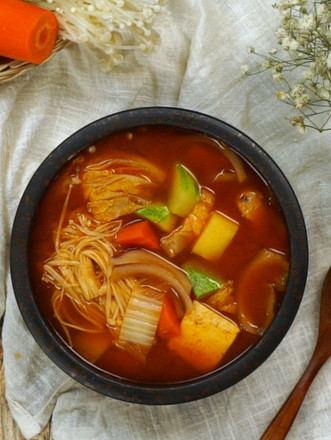
There are more than 200 kinds of pickling methods for kimchi. This is a very simple one. I always feel that the food does not have to be complicated. Sometimes it is cooked with love to make it more delicious...
It seems that there are many steps, but it is actually very simple. For everyone to see clearly, take a step-by-step record.
 Buy on JD
 Buy on Amazon