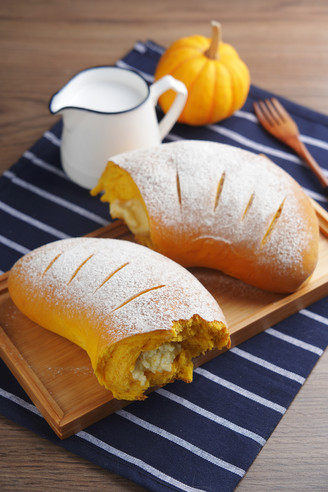
Cuckoo Bread
1. Soak raisins, dried cranberries and dried blueberries in rum overnight in advance (you can change the dried fruit to your favorite type, and you can also add nuts, whatever you like).
2. Pour the milk and egg liquid into the bread bucket, place the granulated sugar on the corner of the bread bucket, place the salt on the opposite corner of the sugar, pour the flour, and finally sprinkle the dry yeast on the flour (to prevent the yeast from contacting the salt).
3. Start the bread machine "kneading" function (my bread machine defaults to 20 minutes), when the dough is kneaded, pause the machine and knead the dough with your hands. The dough is soft and there will be a little sticky on your hands. This humidity is suitable , Start the bread machine to continue kneading. If the dough is hard, add a small amount of milk until the dough is soft; if the dough is too wet and sticky, add a small amount of flour.
4. After a "kneading" process is over, take a small piece of dough and slowly stretch it out. The film will break if you can't stretch out a large piece of dough.
5. Add softened butter and start the "kneading" program again.
6. At the end of the second "kneading" process, take a small piece of dough and slowly stretch it out. At this time, you can pull out a large piece of film that is not easy to break.
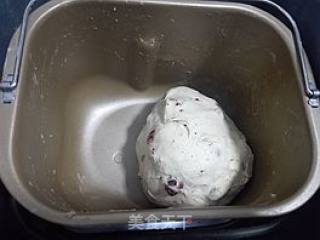
7. Take out the soaked dried fruits, drain them, and knead them into the dough.
8. Cover a piece of baking grease paper on the bread bucket, and flick some drops of water on the grease paper.
9. Then cover a wet towel on the greased paper, then close the lid of the bread machine, and wait for the dough to rise. If the weather is cold, you can turn on the "fermentation" function of the bread machine, and when the weather is warm, you can wait for the dough to ferment naturally.
10. When the dough has doubled in size, use your fingers (dip in water or dry flour to prevent sticking) and poke a hole in the dough. If the hole does not rebound (it is not well) or collapses (it is well), it means that the degree of fermentation is just right.
11. Take out the dough and ventilate, divide into 8 portions, round, cover with plastic wrap (to prevent the dough from drying out) and relax for 15 minutes. When the dough is loose, spread a thin layer of butter in the mold and evenly sprinkle a layer of almond slices.
12. Button a hole in the middle of the small dough, put it into the mold, and cover it with plastic wrap (to prevent the dough from drying out) for secondary fermentation.
13. When it is more than one and a half times, it does not exceed twice the size (press the surface of the dough lightly with your fingers, and it will rebound slowly). Put the upper and lower fires in the middle and lower layers of the oven preheated at 180 degrees, adjust the upper and lower fires to 170 degrees and bake for about 20 minutes. The surface is golden, and the surface will bounce immediately when you press it. If the coloring is enough but the bread is not yet cooked and you need to continue baking, cover with a piece of tin foil to prevent the color from becoming too dark.
14. Immediately after being out of the oven, it will be buckled out of the mold.
15. After cooling, sift a layer of powdered sugar and enjoy. If you can't finish it, put it in a bag and seal it tightly.
Tips: 1. The baking temperature and time are for reference only, and must be adjusted according to your own oven.
2. This bread has a hard texture the next day. If you don't like hard, you can bake it a little and eat it softly.


 Buy on JD
 Buy on Amazon