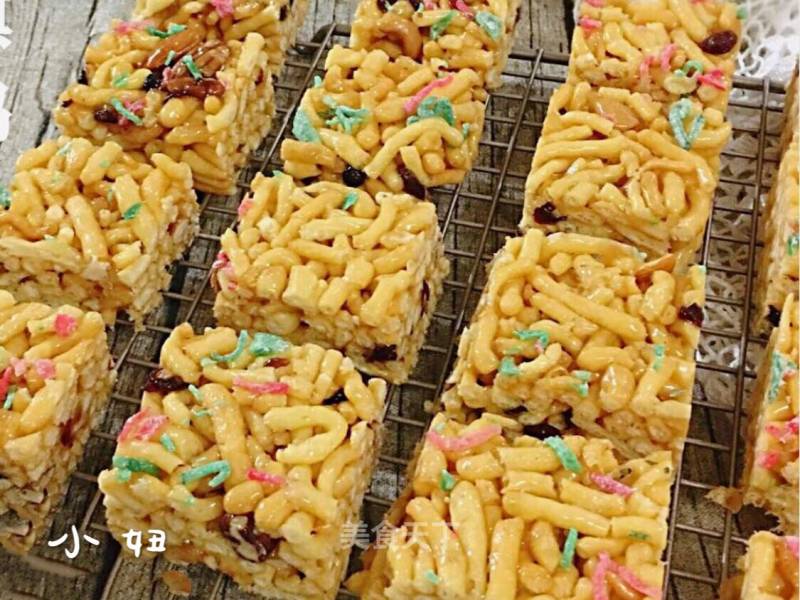
Taoren Shaqima

by Chick_hebycE

4.9 (1)
Favorite
1

Difficulty

Normal

Time

10m

Serving

2

Shaqima is a luxury item that I never forget every day when I was a child. Huang Dengdeng's is covered with sesame seeds and green red silk. It looks very beautiful. When relatives visit during the Spring Festival, I can only eat this gift with my mother. When my three siblings each had one piece, we were reluctant to eat. We first pinch off the green and red silk on top with our hands little by little and put it in our mouths to taste slowly, and then bite off the top layer of sesame. In the end, I was very reluctant to eat a whole piece, this kind of memory has been deeply imprinted in my mind...
Searching for Shaqima on the Internet, it was a Manchu food at the beginning, a sacrifice for the San Tombs of the Qing Dynasty. The original meaning was "dog milk dipped in sugar", which means that noodles are fried and mixed with sugar and cut into small pieces. It is one of the famous Beijing-style four-season pastries in Beijing. Its preparation is simple and quick, with a soft and sweet taste, suitable for all ages. Let's take action together and make a deluxe version of Walnut Sachima! "

Taoren Shaqima

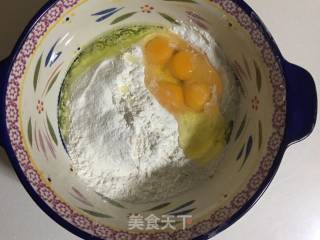
1. Mix 300 grams of regular powder, 4 grams of baking powder and 1 gram of baking soda, and add four large eggs;

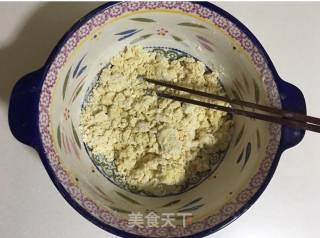
2. Use chopsticks to stir into flocculent;

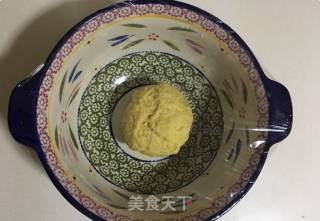
3. Integrate into dough (no need for tendons), cover with plastic wrap and relax for 1,2 hours;

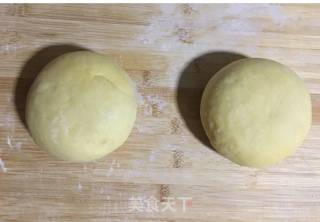
4. Sprinkle starch on the chopping board and divide into two portions;
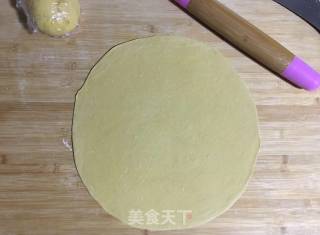
5. One part is covered with plastic wrap and sealed, the other part is flattened by hand and rolled into a rectangular sheet about 0.3 cm thick with a rolling pin;

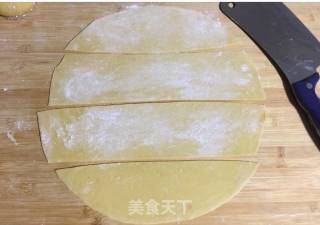
6. Divide into four equal parts;

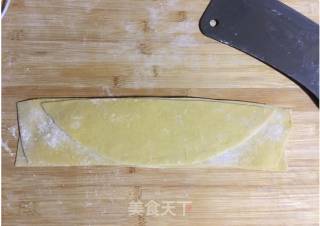
7. Sprinkle with starch and press together;

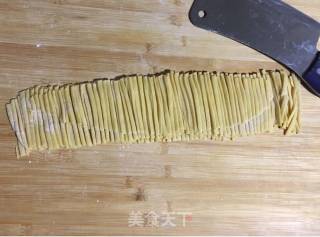
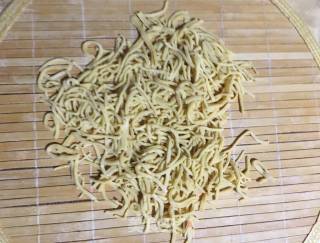
8. Cut into very thin strips;

9. Tear open the noodles and shake them on the sieve to shake off the excess flour;

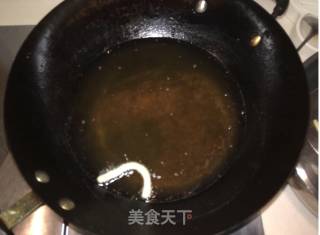
10. Put the oil in the pan and heat the oil to 180 degrees Celsius over a medium and small fire (or pre-place one and float it up to indicate that the oil temperature is appropriate);

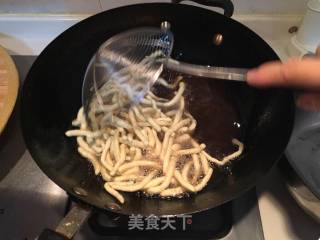
11. Shake off the starch with your hand and put it in a frying pan, turn it over with chopsticks until it is slightly colored and fished out;

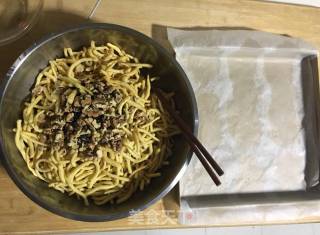
12. Pour in the peach kernels and sesame seeds, mix evenly and set aside, spread oil paper on the baking tray;

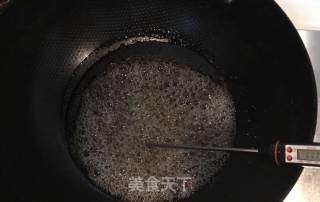
13. Put 130g caster sugar, 250g barley sugar and 60g water in the pot, heat it on a low fire and stir it evenly, then heat it to 115 degrees and it will bubble (be careful not to stir in the middle to make sand) and sticky;

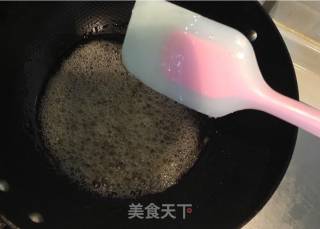
14. Try to stretch the filament;

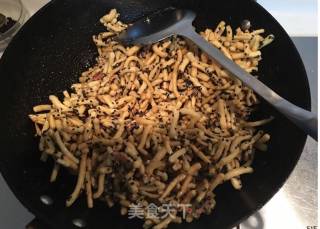
15. Pour the mixed materials into the syrup quickly, and stir evenly with a spatula;

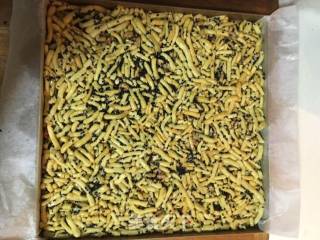
16. Pour it into a mold covered with greased paper (or put a layer of grease on the baking tray to prevent staining);

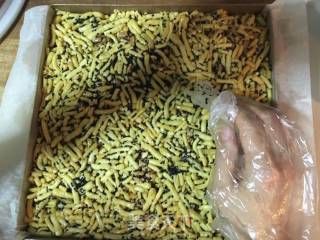
17. Put on gloves to flatten (or flatten with a trowel), compact and shape;

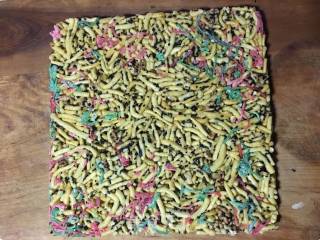
18. Pour out while it is still warm (a little green and red silk is sprinkled on the bottom of my baking tray);

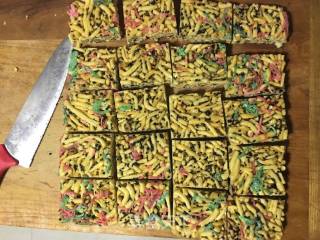
19. Let cool after dicing;

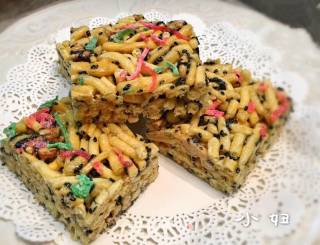
20. Finished picture

21. Finished picture

Tips:

1) Reserve liquid when kneading dough to prevent the dough from being too soft. 2) Sprinkle the noodles with hand powder to avoid sticking. 3) The boiled syrup should not be too thin, but not too thick. Use a spatula to try the kind that can hang the flag, that is, it can be stretched to prove that the concentration is appropriate. 4) When mixing the syrup and the fried noodles, the action should be quick to avoid premature solidification of the syrup, and it is easiest to cut into small pieces when the syrup is warmed up. The above is for reference!

Comments

Similar recipes

Braised Eggplant

Eggplant, Salt, Flour

Pimple Soup

Ginger, Parsley, Chives

Seasonal Vegetable Pie

Flour, Plain Water, Cucumber

Pimple Soup

Flour, Tomato, Water

Seasonal Vegetable Quiche

Green Bean Sprouts, Carrot, Shiitake Mushrooms

Seasonal Vegetable Soup Baba

Flour, Tomato, Sausage

Cornmeal Fried Dumplings

Glutinous Rice Balls, Flour, Cornmeal

Pimple Soup

Tomato, Flour, Rape